Demonetisation
Source –Business Line
Date of
Publication-Wednesday 8 November 2017
Note – Many students
are making project on demonetization The below article which has been taken
from business line shows the positive view of demonetization
It can be a great help
to students who are preparing for project and also for group discussion in various
entrance examination

Topic Demonetization
Adapted
from - It’s a major structural change
Author
– Arun Jaitley – Finance Minister
Synopsis – Finance Minister believes that the
initiative has also introduced a higher degree of ethics in Indian society
Q1 India is a cash dominated economy What does it
mean
Answer
1 India is one of the
few economies in the world which has been excessively cash-dominated. A
cash-dominated economy has several features, the most obvious being that the
percentage of cash currency in circulation in relation to GDP is very high. In
India, it was between 12 and 12.5 per cent; 86 per cent of this currency was
high denominational — Rs 500 and Rs 1000.
Q2 What is the effect
of cash economy in our country in terms of economics?
Answer 2 It would also
lead to economic activity. But this informal economic activity would be outside
the formal order. The net result has been that the size of the formal economy
contracted and that of the shadow economy became much larger
Q3 What is social
impact of cash economy
Answer 3 Social
impact
Cash also has social
consequences. It leads to corruption. The instrument of bribery is always cash.
Cash leads to expenditure on conspicuous items like gold and luxury items. Cash
is also the instrument for fuelling crime, extortion. Terrorism thrives on cash.
And, therefore, in the larger national and public interest as also for good
economic reasons, the quantum of cash in the society and the economy has to be
curbed.
Q4 What steps
government has taken earlier to curb the black money previously
Answer 4 a) In 2011, the
Supreme Court had asked the Government to appoint a Special Investigation Team
(SIT) headed by two retired judges.
b) A scheme was introduced that those who have
illegal money and assets abroad must bring them back on payment of 60 per cent
tax and penalty or they will be prosecuted. The Black Money Law for overseas
assets was enacted and it provided for a 10-year punishment.
c) The government started entering into
agreements with countries across the world through G20, the FATCA agreement
with the US to improve international tax compliance through mutual assistance
in tax matters, agreement with Switzerland so that we can get real-time
information with regard to transactions done by Indians overseas and
vice-versa. Three major international double tax avoidance treaties with
Mauritius, Cyprus and Singapore have been rewritten.
d) The government then brought in the Benami law which brings
into its ambit businessmen and politicians alike and applies to shell companies
through which money is laundered. We brought in the income disclosure scheme to
disclose income which has escaped assessment.
e) Finally, on
November 8, 2016, the Government took the historic decision of demonetising the
Rs 500 and Rs 1000 notes.
Q6 What were the objectives and
achievement of demonetization
Answer6 a) The first, of
course, was that the quantum of cash should be curbed.
b) The number of
individuals paying tax and filing assessments has significantly increased
c) An incidental
advantage that we have seen is that freezing of funds of terrorists operating
in Jammu and Kashmir and Chhattisgarh has taken place. The nature of protests
there which depended on large economic resources has altered.
d) A
currency note is a bearer document. Its ownership is anonymous. The moment it
gets deposited in the bank account, it gets identified with the owner. The onus
is now on the owner to show that the acquisition of such a large amount of
money was legitimate or otherwise. And under Operation Clean Money, we have
been able to identify through data mining 1.8 million people who made deposits
disproportionate to their known sources of income.
Questions for Viva for the students who are making project
on demonetization
Has the use of cash
come down post demonetisation?
The currency with the
public is down by Rs. 3 lakh crore. The positive spin is that Indians are
getting out of the cash habit and are moving to non-cash payment. The negative
spin is that the reason the cash has not come back is that the cash economy is
in such bad shape that they can’t absorb that money.
What has happened to
black money?
There is total
confusion. Black money is not kept under the pillow or in bank lockers. It is
almost always put to some use. It is either used to buy valuables like real
estate and gold or is anonymously invested in stocks or sent abroad. A bulk of
it goes into financing the informal sector. All this is black money because it
is not taxed. All this came back into the banking system and all of it except
Rs. 3 lakh crore has again been withdrawn. GST will make a lot of impact on
black money as it will help generate a paper trail.
One year later, what
has been the impact of the note-ban on the economy?
Agriculture has
suffered quite significantly and, in effect, there have now been three
successive years of agriculture distress — two because of droughts and one
because of demonetisation. Last year’s kharif crops were partially compensated
and were reasonable but the full impact of demonetisation was on this year’s
rabi crop. There has also been slackening of demand for corporate India.
The rupee appreciated
significantly and imports shot up. So domestic companies have been unable to
expand their exports and are having a hard time maintaining their market share
in India through import competition.
Are there chances of a
revival in the economy from the second quarter?
I think the entire
year is going to be bad. In the second quarter, there will be two conflicting
influences operating. The positive effect will be that the de-stocking before
GST will be reversed.
The negative effect is
that supply chain problems arising out of GST will start playing out. But, from
the third quarter, we will only be left with the GST effect, which will be
negative.
The impact of
demonetisation on demand will also continue until the rural sector picks up. We
have to carefully watch what’s happening at the mandi level to the kharif crop
which comes in now. If there is another price crash, we are in deep trouble.
It’s a year since the
government opted for demonetisation. Do you still believe it was a right
decision, given its impact on the GDP?
I still stand by my
views on demonetisation. It is a decisive attack on the whole culture of black
money. You can say it is draining the swamp. Yes, there has been an impact on
GDP. But a major decision like this comes at a cost. The process of changing
the culture of illegality is slow but it is happening. It is wrong to say that
all blackmoney has turned into white. It has turned grey. The dubious money is
now sitting in bank accounts that are under scrutiny. See for example the
changing process in defence and real estate. Yes, economic activities were
impacted by this. But this was because the economy was readjusting itself to
the changed structure. Today dishonesty is not incentivised.
But how do you assess the
success of demonetisation, considering the RBI is still counting the currency?
This is a constant
question. How much has come in? Why don’t you see it like this — there are 18
lakh accounts, of which 13 lakh accounts have been identified and are under
scanner, about 4,000 accounts have already been acted against by the
government. These have yielded ₹5,000 crore. The whole process has sent a strong signal to all
that there is no scope for such activity.
Some critics say — won’t
dumping the currency have sent a stronger message...
If the government had
instructed something like this it would have created a ripple (smiles), created
a thrill, but would not have achieved the desired impact. Things have to be
done step-by-step.
Debate has also taken place
on the frequency of demonetization and whether the government should do away
with high-denomination notes (₹2,000). As an economist what
will you propose?
Not demonetisation,
but currency replacement can happen if, say, the government wants to shift to
all-plastic instead of paper, or to make certain changes in a particular
denomination. As regards the higher denomination currency, I would think a
better idea is to do how it is done in the developed world — link it to per
capita income. In the US, the highest denomination is $100 when the per capita
income is nearly $40,000. We have to similarly calibrate our currency.
Hasn’t GST impacted the
consumption pattern?
We have to see
everything in a perspective. See what kind of economy we want. Do you want to
be Japan or you want to be Brazil? India should target Japan, where the set-up
is aimed at larger growth of the middle-class. The Japanese society has far
less inequality and yet prosperity for the middle-class.
GST has impacted the
consumption demand, but of luxury items, not rural consumption.
The rural economy has
not been impacted because agriculture has been out of income-tax net. Success
will come about if this move leads to replacing consumption demand with
investment demand.
To clean up the economy there
have to be major reforms in the taxation structure. The government has taken a
major initiative in indirect tax reforms (GST). What about direct taxes?
Yes, I agree. But
credit to this government that it has taken the initiative of cleansing a
termite-ridden system that was never touched by successive governments earlier.
Today, the tax system is far more transparent.
For direct tax also
there is everything online just as is the case with indirect tax now. More will
happen.
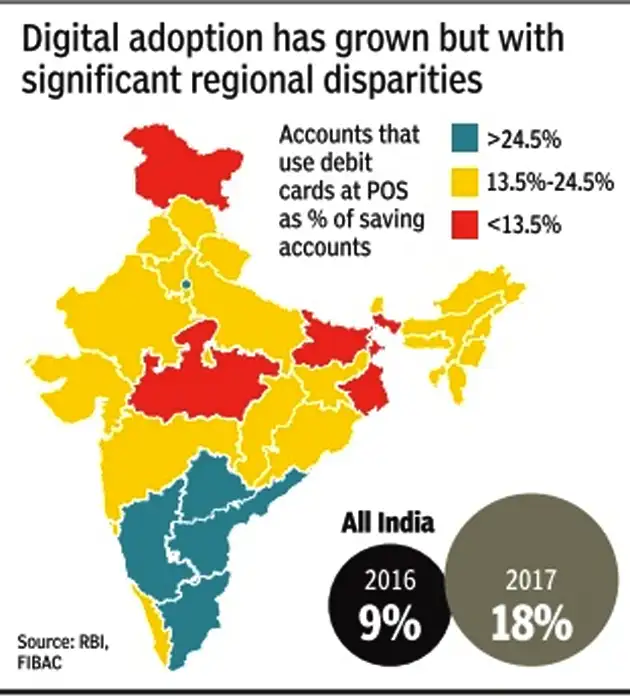
How to move to a cash less economy
How to move to a cash less economy
Despite the push to cashless transactions through a variety of digital
payment options, Indians seem to be going back to using cash a year
after demonetisation. A recent study by MicroSave tracks the efforts to
promote a less cash society by public sector banks and the National
Payments Corporation of India.
Key Steps: “The task of building a less cash eco-system is colossal but not impossible,” according to the study.
Identify and on-board merchants: Merchants become critical in promoting a less cash ecosystem, especially in rural India.
Installing acceptance infrastructure: Once merchants have been
on-boarded, banks must provide appropriate acceptance infrastructure at
their shops. Options can include economical and compact card swiping
m-PoS terminals or platforms such as BHIM Aadhaar Pay, Bharat QR Code
Train merchants to facilitate digital payments: Merchants must be trained in conducting digital transactions, and in turn they can train customers, especially in rural areas.
Customer education: Mass media platforms, financial literacy
campaigns, live, hands-on training on digital transactions and create
“product champions” at the village level to promote a steady uptake of
digital payments.
Graphs to be referred – These graphs can also be helpful to teach students presentation of data




Comments
Post a Comment